
Percent Yield Calculator
Calculate percent yield in one step from your actual and theoretical yield, or let the calculator find the theoretical yield from the mass of the limiting reactant, the molar masses and the mole ratio in the balanced equation.
- Free to use
- No sign-up
- Runs in your browser
Calculate percent yield
Find the theoretical yield first
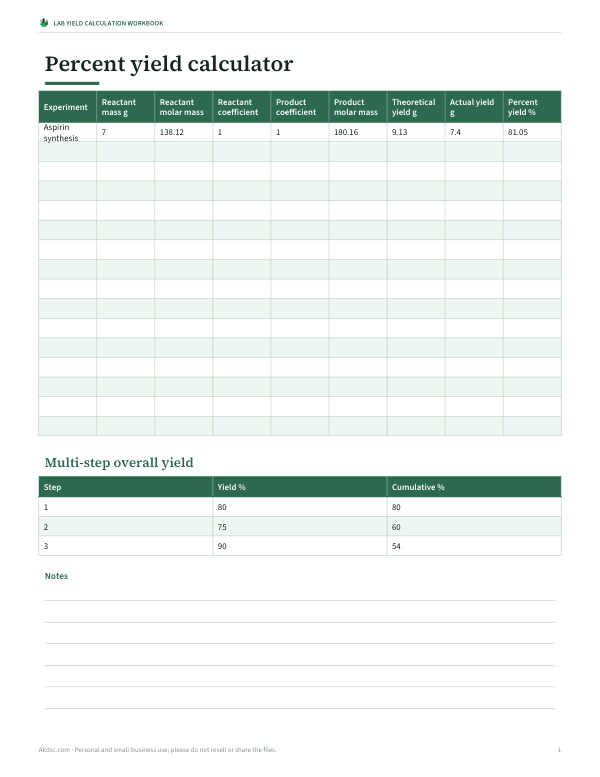
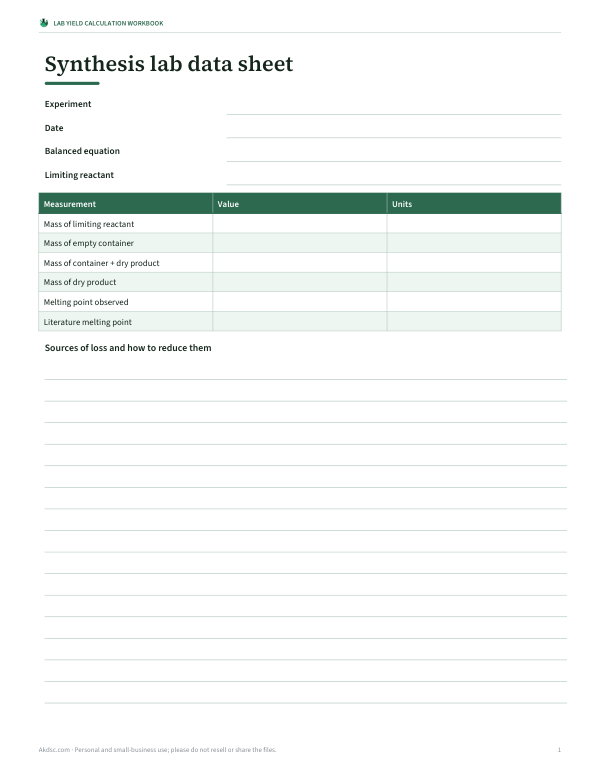
Lab Yield Calculation Workbook
A reusable lab workbook for theoretical yield, percent yield and multi-step overall yield, plus a printable lab data sheet.
- Yield workbook (XLSX, PDF)
- Lab data sheet (PDF, DOCX)
Formats: XLSX, PDF, DOCX. Instant download after payment (link valid 72 hours, up to 5 downloads). AI-assisted: the templates were drafted with AI help and reviewed and laid out before publishing.
$5.00 USD, one-time
- Instant download
- 7-day refund
- Secure checkout by Stripe
7-day money-back guarantee. Full refund within 7 days of purchase, even after you download.
Full refund within 7 days — see the refund policy and license.
Free printables
Single sheets you can print right now, no sign-up. The full pack adds every sheet in one download plus the editable files.
The percent yield formula
Percent yield compares how much product you actually obtained with the maximum amount the reaction could have produced:
- Percent yield = (actual yield ÷ theoretical yield) × 100%.
- Actual yield is what you measured — usually the mass of dry, purified product.
- Theoretical yield is calculated from the balanced equation and the amount of limiting reactant.
Both yields must be in the same units — grams with grams, or moles with moles. The result is dimensionless.
Finding the theoretical yield
The theoretical yield comes from stoichiometry: convert the mass of the limiting reactant to moles, use the mole ratio from the balanced equation to get moles of product, then convert to grams. The second calculator does this from the chemical formulas you type: it calculates both molar masses from standard atomic weights, applies your coefficients, and reports the theoretical yield and the percent yield together.
Worked example: making aspirin
Aspirin (acetylsalicylic acid, C₉H₈O₄) is made from salicylic acid (C₇H₆O₃) and acetic anhydride in a 1:1 ratio of salicylic acid to aspirin. A student uses 7.0 g of salicylic acid as the limiting reactant. Its molar mass is 138.12 g/mol, so 7.0 g is 0.0507 mol. The same number of moles of aspirin, at 180.16 g/mol, gives a theoretical yield of 9.13 g. If the student collects 7.4 g of dry aspirin, the percent yield is 7.4 ÷ 9.13 × 100 = 81%.
Why yields are below 100%
- Incomplete reaction — some reactant never converts, especially for equilibrium reactions.
- Side reactions — reactants form unwanted by-products.
- Losses during work-up — product left on filter paper, in the flask or dissolved in the washing solvent.
- Purification — recrystallisation improves purity but always loses some product.
- Transfer and weighing errors — small amounts matter at the gram scale.
Yields over 100%
A percent yield above 100% is physically impossible for a pure product, so it points to a problem: the product may still be wet with solvent or water, contaminated with unreacted starting material or by-products, or the masses may have been recorded incorrectly. Drying the product to constant mass and checking purity — for example with a melting point — usually explains it.
What counts as a good yield?
| Percent yield | Typical interpretation |
|---|---|
| 90–100% | Excellent |
| 70–90% | Good |
| 50–70% | Fair — common in multi-step student labs |
| Below 50% | Poor; look for losses or side reactions |
Expectations depend on the reaction and scale. In multi-step synthesis the overall yield is the product of each step's yield, so three steps at 80% each give only about 51% overall.
Percent yield, percent error and atom economy
Percent yield measures how much product you obtained. Percent error compares a measured value with an accepted value and is a different calculation. Atom economy, used in green chemistry, measures how much of the mass of all reactants ends up in the desired product according to the balanced equation, regardless of how well the reaction was carried out. A reaction can have a high yield but poor atom economy if it produces large amounts of by-products.
Lab-report tips
- Report the limiting reactant and show how you identified it.
- Show the mole calculation for the theoretical yield with units at each step.
- State whether the product was dried to constant mass before weighing.
- Discuss specific sources of loss rather than “human error”.
- Round the final percent yield to the precision your balance supports — usually three significant figures.
Industrial and real-world yields
Yield matters far beyond the teaching lab. In pharmaceutical and fine-chemical manufacturing, every percentage point of yield in a multi-step synthesis can change the cost of the final product significantly, because losses compound across steps. Chemists therefore optimise temperature, concentration, reaction time, catalyst choice and purification methods to push each step as high as practical, often trading a little yield for better purity or safety. The same calculation you use for a school experiment — actual divided by theoretical — is the number process chemists track batch after batch.
Improving your yield in the lab
Small technique changes make a measurable difference. Scrape and rinse the reaction flask with a little cold solvent and add the rinsings to the filter. Wash crystals with small portions of ice-cold solvent rather than one large portion, so less product dissolves. Allow enough time for crystallisation, cooling the mixture in an ice bath at the end. Dry the product completely before weighing, but do not heat heat-sensitive compounds. Recording the mass of the empty, dry filter paper or watch glass first makes the final weighing more accurate.
Frequently asked questions
How do you calculate percent yield?
Divide the actual yield by the theoretical yield and multiply by 100.
What is theoretical yield?
The maximum amount of product possible from the limiting reactant, calculated from the balanced equation.
Can percent yield be over 100%?
Not for a pure, dry product. Over 100% usually means the product is wet or impure, or there is a measurement error.
Do I use grams or moles?
Either, as long as actual and theoretical yield use the same unit.
What is a typical student lab yield?
Often between about 50% and 90%, depending on the reaction and technique.
How do I find the limiting reactant?
Convert each reactant to moles and divide by its coefficient; the smallest value is the limiting reactant.
Should I use the mass before or after drying?
After drying to constant mass. Residual solvent or water inflates the actual yield and can push the result above 100%.
Is percent yield the same as purity?
No. Yield measures how much product you recovered; purity measures what fraction of that product is the desired compound. A high yield of impure product can be misleading.